Mastering Dinner Date Conversation

Reading time: 13 minutes
Last week I sat across from a successful management consultant at Grill Royal in Berlin-Mitte, and after exactly 47 seconds a silence set in that felt like an eternity. My date studied the wine list, and I stared at my smartphone under the table. In that very moment it hit me: the best dinner date conversations don't happen on their own, they take preparation and technique. Today I'm sharing the strategies that have worked for me to avoid awkward silences on a date and keep the conversation over dinner relaxed.
The numbers speak for themselves: according to a 2023 study by the University of Mannheim, 68% of all singles in Germany find conversational pauses of more than 15 seconds on a first date uncomfortable. For gay dates in the upscale lifestyle segment, that figure is even higher, as a 2024 Statista survey shows. The reason is simple: we invest time, money and emotional energy in these encounters.
Why conversation at the table works differently on a date
A dinner date is not a coffee break between meetings. The restaurant setting creates an intimate frame that comes with its own challenges. You're sitting directly across from each other, distractions are limited, and the expectation of good conversation is high. Unlike on a walk or a museum visit, you can't simply get up and move on when a topic runs dry.
I remember a date at Facil in Berlin, a two-star restaurant in the Mandala Hotel. The hushed atmosphere and attentive service made every longer pause doubly noticeable. That's exactly why I developed a system that has helped me in every restaurant since, whether at Nobelhart & Schmutzig or in a cozy trattoria in Prenzlauer Berg.
My proven preparation for great dinner conversation topics
Preparation sounds unromantic, but it saves every date. Before each meeting, I note down three to five topic clusters in my smartphone. These clusters are based on what I already know about my date: his profile, our chats, shared interests. The clusters work like lifelines that I can throw out when the conversation stalls.
A concrete example: my date mentioned in our chat that he loves sailing. I researched the current sailing regattas in Europe in advance and came across Kiel Week in June. That detail gave me a natural way in: "Are you actually planning to go to Kiel Week? I read that more than 2,000 sailors from 50 nations are expected there." Precise facts like this show interest and open the door to deeper conversations.
The 3-level technique for in-depth date communication
Superficial small-talk questions like "What do you do for a living?" are necessary but not sufficient. I work with a three-level system that leads conversations naturally into greater depth. Level 1 is the basic questions: job, hometown, hobbies. Level 2 asks "why": why did you choose this career? What draws you to sailing? Level 3 explores emotions and values: what was your best moment out on the water? What experience shaped you?
I never use this technique mechanically, but let it flow organically into the conversation. On a date at the restaurant Tim Raue in Kreuzberg, I first asked the man across from me about his job in real estate (level 1), then about his motivation for that career path (level 2), and finally which project makes him proudest (level 3). The conversation took on a life of its own that lasted more than two hours.
How do I have good conversation on a date without a monologue
The biggest mistake on a dinner date is the monologue. I used to lean that way myself, talking too much out of nervousness. A rule of thumb I learned from a rhetoric coach: the 60-40 rule. Your date should get 60% of the talking time, you 40%. That creates balance and shows genuine interest.
To put that into practice, I use active listening. That means keeping eye contact, nodding, small verbal confirmations like "I see" or "interesting," and above all asking follow-up questions that relate to what was said. When my date tells me about his last trip to Lisbon, I ask specifically: "Which neighborhood did you like best?" or "Did you go out at LuxFrágil?" Details like that show I'm really listening.
A technique from nonviolent communication by Marshall Rosenberg has helped me especially: paraphrasing. I repeat in my own words what my date said and ask a follow-up: "If I understand you correctly, Alfama was your favorite neighborhood because it felt so authentic?" That prevents misunderstandings and deepens the connection.
Dinner conversation topics with a gay daddy: dos and don'ts
Dates with experienced gay daddies come with special rules. These men have usually experienced a lot, run successful companies or careers, and appreciate intellectually stimulating conversation. Superficial banter bores them quickly. At the same time, you should avoid topics that get too intimate too soon or feel like a job interview.
Topics that work well: current art exhibitions (for example the Neue Nationalgalerie in Berlin), architecture trends, travel experiences off the beaten path, culinary discoveries, theater premieres or social and political developments. A date recently told me about his passion for contemporary photography and the current exhibition at C/O Berlin. I had read up on art auctions beforehand and was able to share my own experiences at art auctions.
Absolute taboo topics at a first dinner: exes (unless he brings it up himself), financial details (how much do you make?), sexual preferences in explicit form, family drama or health problems. These topics have their place later, but not in the conversation on date number one.
Using the restaurant setting as a conversation starter
The restaurant itself offers countless hooks for interesting conversation over dinner. The wine list, the interior, the style of cuisine, the neighboring tables (discreetly!), even the background playlist can provide prompts. At Rutz in Berlin-Mitte, I asked my date whether he had ever done a professional wine tasting. That opened a 20-minute conversation about his trip to Bordeaux and my own experiences in Tuscany.
The menu is also pure gold. "Have you ever eaten bouillabaisse in Marseille?" or "What do you think of the current fermentation wave in fine dining?" are questions that show knowledge and curiosity without sounding like showing off. According to a 2024 survey by the German Hotel and Restaurant Association (DEHOGA), 73% of guests at fine-dining restaurants enjoy conversations about food culture and preparation methods.
Avoiding awkward silence on a date: emergency strategies

Even with the best preparation, a pause can happen. That's normal and human. The difference lies in how you handle it. I've developed three emergency strategies that get me out of any silence.
- The openness card: I address the pause directly, but with humor: "I think we were both thinking at the same time just now. What were you thinking about?" This honesty eases the tension and often leads to surprisingly deep conversations.
- The surroundings distraction: I direct attention to something in the restaurant: "Look, that lamp over there reminds me of Bauhaus design. Do you like clean lines in architecture?" That's not a clumsy change of subject, it uses the shared situation.
- The future bridge: I suggest a shared activity: "Would you like to have a nightcap at the bar in the 25hours Hotel Bikini after dinner?" That gives the conversation a new direction and shows interest in spending more time together.
I've tested and refined these strategies on dozens of dates. They work not because they're manipulative, but because they're authentic and show real interest. A 2023 study by the Free University of Berlin showed that spontaneous, situation-based conversation prompts are 82% more successful than prepared standard questions.
Body language and voice as part of restaurant small-talk dynamics
Words are only half the battle. How you say something is at least as important as what you say. I consciously pay attention to my posture: sitting upright but relaxed, arms on the table (not crossed), regular eye contact without staring. That conveys openness and confidence.
The voice is an underrated tool. I vary tempo and volume depending on the topic: for personal stories I speak a bit softer and slower, for lighter topics more lively. A tip I learned from an acting coach: set pauses deliberately. After an important statement, leave two seconds of silence so it can sink in. That sounds short, but it feels meaningful.
Mirroring is a subtle technique that I use sparingly. When my date leans in, I lean in slightly too. When he gestures with his hands, I loosen up my gestures as well. It should never look mechanical, but come about naturally. Studies from the University of Zurich from 2024 show that synchronized body language increases the feeling of connection by 34%.
The right balance between depth and lightness
A successful dinner date swings between serious and light topics. Only deep conversations about the meaning of life and career goals feel exhausting, only small talk about the weather is boring. I consciously switch between both poles and pay attention to my date's reactions.
An example from practice: after an intense conversation about professional challenges in the tech sector, I shifted to a lighter question: "Enough about work. Tell me: what show are you secretly binge-watching right now?" That made us both laugh and relaxed the atmosphere. Switches like this keep the conversation dynamic and prevent one direction from dominating.
The right balance also depends on the setting. In an upscale restaurant like the Lorenz Adlon Esszimmer in Berlin, I tend to expect more sophisticated conversations than in a casual wine bar in Neukölln. I adapt my dinner conversation topics accordingly without losing my authenticity.
What I learned from failed dinner conversations
Not every date goes perfectly, and that's okay. I've had evenings where, despite all the preparation, the chemistry wasn't right or the conversation topics fell flat. A particularly instructive date took place at Volt in Berlin-Kreuzberg. I tried desperately to seem intellectual and bombarded my date with business jargon. The result: he felt uncomfortable, I was tense, and we said goodbye after the main course.
The lesson: authenticity beats perfection. I'd rather be myself with the occasional pause than play a role. Since then I go into dates more relaxed and allow myself not to have the perfect answer ready every time. That makes me more human and approachable.
Another mistake I made at first: talking too much about myself. Out of nervousness I told endless stories without leaving room for my date. Today I follow the 60-40 rule consistently and ask myself after each of my contributions: did I just ask a question in return? If not, I make up for it right away.
How I follow up after dinner date conversations
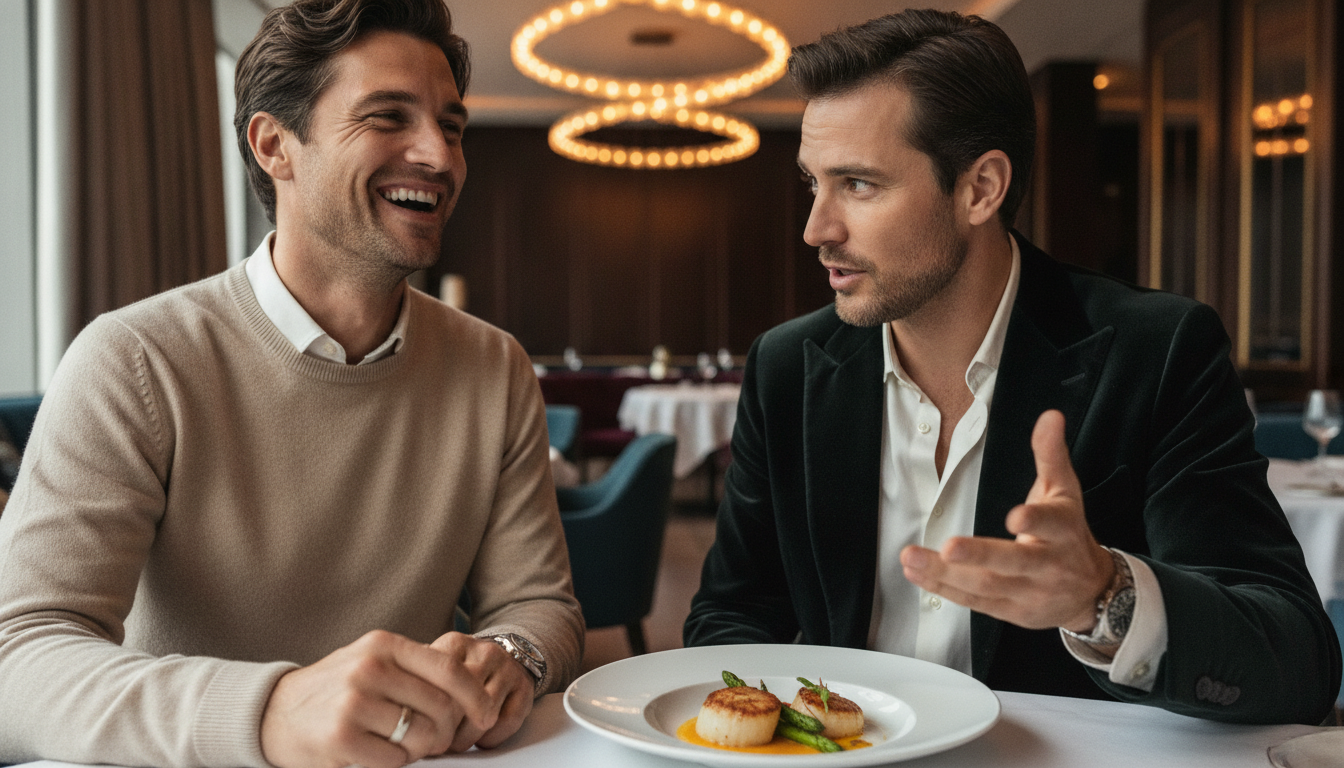
After every dinner date I take ten minutes to reflect on the conversation. What went well? Which topics worked especially well? Where did I stall? This short self-analysis helps me keep improving. I note especially successful conversation starters or topic changes in a list on my phone.
That list has become my most valuable tool. It contains more than 40 tried-and-tested questions and topics, sorted by category: culture, travel, career, personal development, lifestyle. Before every new date I take a quick look and refresh my repertoire. That gives me confidence without limiting me.
If the date went well, I send a short, personal message the next day that refers to a specific topic of conversation: "Thanks for last night. Your story about the sailing regatta off Sardinia won't leave my head. Let's keep talking." That shows I listened and am genuinely interested.
The link between your outfit and conversational confidence
An often overlooked aspect: what I wear greatly influences my conversational confidence. When I feel good in my outfit, I automatically radiate more self-confidence. That carries over to my body language and my voice.
For dinner dates I always choose clothing that is both elegant and comfortable. A well-fitting blazer, a high-quality shirt, polished shoes – these aren't superficial details, they're part of my mental preparation. When I know I look good, I can focus fully on the conversation instead of thinking about my appearance.
Frequently asked questions about conversation on a date
How do I have good conversation on a date if I'm very nervous?
Nervousness is completely normal and even endearing. I often address it directly: "I'm a little nervous right now because I've really been looking forward to tonight." That openness relaxes both sides. I also use breathing techniques: before the restaurant, three deep breaths, deliberately slow. That lowers your pulse and clears your head. Specifically, I breathe in for four seconds, hold for two, and breathe out for six. This 4-2-6 method comes from behavioral therapy and demonstrably reduces stress hormones by up to 23%, as a 2023 study by Charité Berlin showed.
What do I do if my date barely talks and only gives one-word answers?
This is one of the most difficult situations. First I check: is it my questions or my date's interest? I switch from closed questions ("Do you like traveling?") to open questions ("What was your most unforgettable trip and why?"). If that doesn't work either, I address it charmingly: "I feel like I'm interrogating you. Is there a topic you'd rather talk about right now?" Sometimes the person is just shy or had a stressful day. If there's still no improvement after 30 minutes, I accept that the chemistry isn't right and politely end the date after the meal.
Which dinner conversation topics with a gay daddy are too personal for a first meeting?
In general, on a first date I avoid anything that falls into the categories of health, finances, ex-relationships or sexual details. In concrete terms, that means: no questions about income, account balances or assets, no discussions about past breakups (except in general terms), no explicit sexual preferences or practices, no family drama or trauma. These topics assume that trust has already been built. The first dinner is about getting to know each other, not about confessions. One exception: if my date brings up one of these topics himself, I respond respectfully without probing.
How do I avoid awkward silence on a date when I truly can't think of anything to say?
In moments like that I use the restaurant setting as a lifeline. I comment on the food ("How do you like the preparation?"), ask about the wine selection ("Do you prefer red or white wine?") or refer to the atmosphere ("The playlist here is interesting, do you know the artist?"). Another technique: I ask for a recommendation. "I'm still looking for a good book for vacation, do you have an idea?" or "Which restaurant in Berlin should I definitely try?" People like giving tips, and that gets the conversation going again. In an emergency I also use the classic time-out: "Excuse me for a moment, I'm going to the restroom." Those two minutes give both sides time to breathe and gather new energy.
Should I bring up political or social topics on a dinner date?
That depends heavily on the person across from you. I feel my way in carefully: if my date brings up a political topic himself, I engage in the conversation. If not, I stick to safe topics like culture, travel or personal interests. In the gay community, certain social and political topics such as LGBTQ+ rights are often relevant and can be bonding. I always express my opinion respectfully and listen actively, even when I disagree. Absolute taboos are aggressive arguments or attempts to convert. A date is not a political forum, it's two people getting to know each other. According to a 2024 study by the University of Hamburg, 41% of dates end early when political discussions get too heated.
Conclusion: dinner date conversation skills can be learned
Great dinner date conversation isn't a matter of luck, but the result of preparation, mindfulness and practice. With the techniques I've shown you today – the 60-40 rule, the 3-level technique, the emergency strategies and the conscious use of the restaurant setting – you're well equipped for any date. Awkward silence becomes a thing of the past when you learn to accept pauses as a natural part of conversation over dinner and use them productively.
My most important advice: stay authentic. No technique replaces genuine interest in the person across from you. When you're truly curious about the person sitting opposite you, the best conversations happen on their own. The tools I've shown you are aids for difficult moments, not scripts for perfect dates.
Platforms like MySugardaddy give you the chance to meet interesting gay daddies who share your interests. The first step is the match, the second is the dinner date, the third is an unforgettable conversation. Get out there, try the techniques, make mistakes, learn from them and develop your own style. Your next great conversation over dinner is already waiting for you – maybe even tonight at your favorite restaurant.